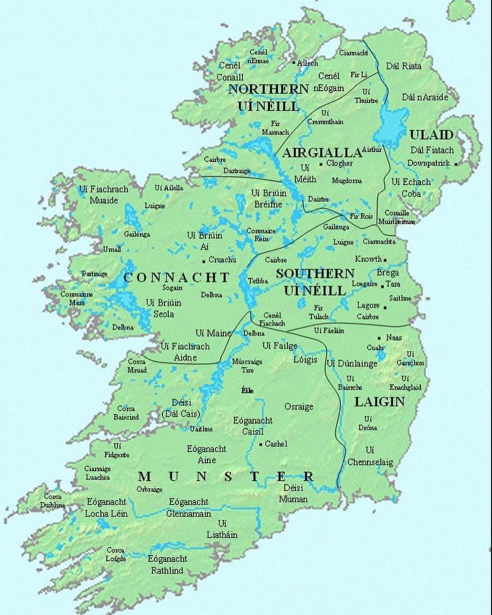
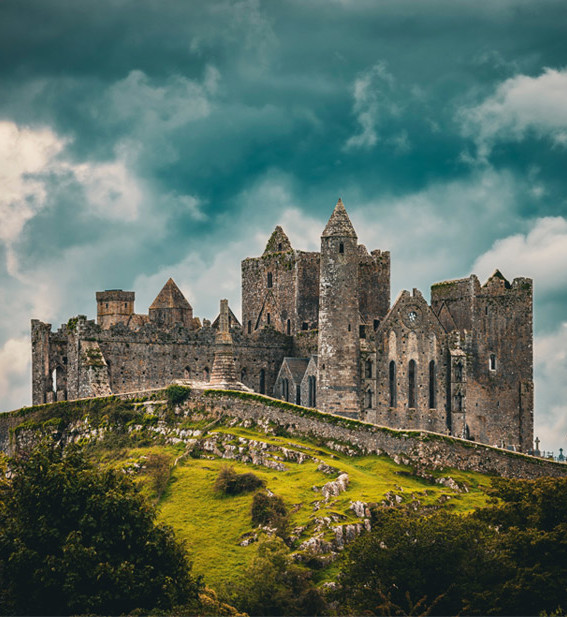
The Island of Ireland with the Mull of Kintyre , Scotland peeping in from the NE.
========================================
Obviously we get a lot of questions about Ireland, history, geography, geology and of course culture. This is a page dedicated to some Odds & Sods of informative pieces where we add ‘stuff’ that we feel may be of interest – and lead (hopefully) to more questioning and enlightenment.
Watch Tom’s excellent presentation of how and why there was a (man-made) ‘famine’ in Ireland – while millions of tons of food left these shores. https://www.youtube.com/watch?v=Wkw9lOx3FGM
============================================
Ireland, Niall Tobin tells us, is 350 miles long and 175 thick.
Ireland by County; some essays pertaining to sites, history, and oddities one may like to peruse.
Tipperary. Cahir. Cahir Castle.
Conchobar Ua Briain (died 1142) was a mid-twelfth-century ruler of the kingdoms of Munster and Dublin.
Conchobar was a son of Diarmait Ua Briain, King of Munster.
In 1138, Conchobar assumed the kingship of Munster.
The Annals of the Four Masters reveals that he gained the kingship of Dublin in 1141.
He died the following year.
It is believed that Conchobar Ua Briain founded what is now known as Cahir Castle in the early 12th century.
Cahir Castle was a state-of-the-art defensive fortress at the time, and continued to be in use for hundreds of years after being gifted to the Butler Family in 1154 by Edward II.
Conchobar ruled alongside his brothers, particularly Tairdelbach Ua Briain, initially sharing power but becoming increasingly dominant, eventually challenging the rising power of Tairdelbach Ua Conchobair in Connacht.
Key Facts:
Family: Son of Diarmait Ua Briain and Mór.
Reign: Became King of Munster around 1138 and King of Dublin in 1141.
Key Events: Assisted by his brother Tairdelbach in gaining power, he succeeded his uncle Muirchertach.
Legacy: Credited with establishing Cahir Castle in County Tipperary in 1142, a significant fortress.
Death: Died in 1142, with the Chronicon Scotorum noting he “rested in repentance in Cell Dalua” (Killaloe).
Significance:
Conchobar represented a resurgence of Uí Briain power in Munster after earlier conflicts, working with his brother to consolidate their rule against rivals like the Ua Conchobairs, though their control was challenged by the Connacht ruler. His reign marked a strong, albeit short, period for the Munster kings before the Anglo-Norman invasions.
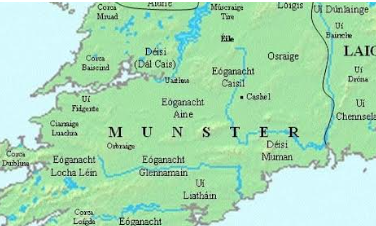
Cahir seat of minor royalty for well over one thousand years. A section of the map of Ireland circa 1400CE.
Because of the fertile soil in the Southeast of Ireland, much of the land here was conquered by the end of the twelfth century. English kings as well as the Normans became very active here from then on.
In 1192 by King John granted this area of Ireland to Phillipp of Worcester who started building a castle here in the early 13th century. He was succeeded by his nephew William Worcester.
The Worcesters married into the De Bermingham family who held the castle until 1375 when it was granted to James 3rd Earl of Ormond who was the head of the Butler family. The castle at Cahir, apart from a few short episodes, remained a Butler castle for the next six hundred years.
The Butler family arrived in Ireland in the latter half of the twefth century. Their original family name was Fitzwalter. Theobald Fitzwalter had been part of the early Norman invasion. He had grown up being fostered in the same household as Prince John and accompanied the prince on a trip to Ireland. Later, he married Strongbow’s daughter Isabel.
Butler was an acquired family name describing a title held by the head of the family in court- ‘butler to the crown’, ‘boitellier’ in Norman French. This ritual role involved serving wine to the king after a coronation. It was a huge privilege in the court and the role came with very attractive entitlements to duty payments of ten percent on all wine imported to Ireland. This right was held by the family for over three hundred years until the English crown bought it back in the 1800’s.
The Butlers coat of arms above the castle gate shows a crucifix on the top right which relates to their Catholicism. Three goblets relate to the role as butlers to the crown, and underneath that you can see three Jerusalem crosses because another relation, Hubert Fitzwalter took part in the third crusade in the 1190ies before he became Archbishop of Canterbury.
Most of the existing castle was built in the 15th century, although there are some later 18th century additions to the castle that can be recognised easily because they were built in red sand stone.
This Castle was built to be an extremely safe stronghold. It was said to be the most impregnable castle in Ireland.
Hence, it was taken by force only once in 1599.
Two cannon balls are still embedded in the castle walls as a reminder of that episode.
In 1599, Queen Elizabeth I sent the Earl of Essex over to Ireland with the goal of defeating Hugh O’Neill, Earl of Tyrone. The successful three day siege of Cahir Castle was part of this campaign, but the Earl of Essex did not have much luck with Hugh O’Neill. On his return to London the queen was outraged at his performance and had him imprisoned in the Tower and executed there two years later, while Cahir Castle was handed back to the Butlers.
In 1650 Oliver Cromwell arrived in Cahir. The Butlers surrendered and handed over the keys- just as well because otherwise the castle surely would have been destroyed by the assault guns used by Cromwell’s army. The Butlers, who were very adaptable and good negotiators, regained control of the castle some 12 years later even though they managed to remain Catholic beyond that date.
Later, when the era of medieval castles concluded, the Butlers built a mansion in the town centre of Cahir where they lived from then on. But the castle remained in their possession until 1961 when the last of the family died without any heirs.
The Castle was purchased by the State and became a National monument in 1964. The castle was beautifully restored. It houses pieces of genuine medieval furniture.
This is one of the largest and most striking of the castles of Ireland, with stunning features such as a working portcullis, cannons, and beautiful crenelations
won the prestigious European Film Commissions Network (EUFCN) Location Award for 2021, a public vote recognizing its role in
The Green Knight and overall appeal as a film location, beating other famous spots like those used for
Dune and
The Crown. The win, announced in February 2022, highlighted its versatility for historical productions, including
Excalibur and
The Last Duel.
====================================================